Why Your AC Runs Constantly and Never Cools the House
September 30, 2026
QUICK ANSWER: An air conditioner that runs nonstop without ever reaching the thermostat setting is almost never a mystery. It usually comes down to lost capacity somewhere in the system: a blocked filter or coil starving airflow, a dirty outdoor unit that cannot release the heat it collects, a duct system leaking cooled air into the attic, or equipment that was never sized for the load it is now carrying. A healthy central air conditioner cycles off periodically even in extreme heat. If yours runs continuously for hours and the house still will not reach the set temperature, the system is working against a real deficit rather than a minor glitch, and it needs a diagnosis before the strain does lasting damage.
The outdoor unit has not shut off since before lunch. Inside, the vents are pushing air, the thermostat display shows the fan running, and the number on the screen has not moved in an hour. You bump the setting down another degree out of habit, knowing it will not help, because the system is already giving everything it has. That is a different problem than an AC that blows warm air or trips off entirely. This one is trying, continuously, and losing.
In Southern Arizona, that scenario gets written off as normal because the outside temperature is brutal and everyone expects the equipment to work hard. Working hard and losing ground are not the same thing, though. A properly matched system that has been maintained still gets periodic rest even on an afternoon when it is a hundred and five degrees outside. When the compressor runs for hours without the house ever catching up, something specific is undermining its capacity, and the fix depends on finding which link in the chain is weak.
What a Nonstop Run Cycle Is Actually Telling You
Every air conditioner is built to remove a certain amount of heat per hour, based on its size and the conditions it was designed for. When the unit runs continuously and the indoor temperature holds steady or creeps upward anyway, that means the heat coming into the house is arriving faster than the system can carry it back out. Something is either adding to that incoming heat load, blocking the system from moving air efficiently, or reducing how much heat the equipment can actually reject once it collects it.
This is a distinct symptom from short cycling, where a unit turns on and off every few minutes without ever settling into a full run. A continuously running system that never satisfies the thermostat points toward a capacity shortfall rather than an electrical or control fault that interrupts the cycle. Working through the possibilities in order, starting with the parts of the system that restrict airflow and moving outward to the equipment itself, is the fastest way to land on the actual cause.
Restricted Airflow Robs the System of Its Working Capacity
Loaded Air Filter
A filter packed with dust and grit chokes the volume of air moving across the indoor coil. Less air over the coil means less heat absorbed per pass, so the system has to run longer to move the same amount of heat out of the house. In a region where dust and monsoon season debris accumulate quickly, a filter that looked fine a few weeks ago can already be limiting performance.
Blocked Or Closed Vents
Furniture pushed against a return, closed doors on bedrooms with no dedicated return path, or supply vents shut to try to direct airflow elsewhere all starve the system of the air it needs to circulate. The compressor keeps running because the thermostat is not satisfied, but the blower cannot deliver enough conditioned air to catch up.
A Coil Already Coated In Dust
If the indoor evaporator coil has not been cleaned in years, a fine layer of grime acts the same way a dirty filter does, insulating the coil and reducing how much heat it can pull from passing air. This tends to develop slowly, so homeowners rarely notice it happening until the system is clearly struggling to keep pace.
The Outdoor Unit May Not Be Able to Shed the Heat It Collects
The compressor's job is to move heat from inside the house to the outdoor coil, where it gets released into the outside air. If that release step is compromised, the whole cycle backs up. A condenser coil caked with dust, cottonwood seed, or landscaping debris cannot transfer heat efficiently, so the refrigerant stays hotter than it should, and the system has to run longer to move the same heat load.
Physical clearance matters just as much as coil cleanliness. An outdoor unit crowded by shrubs, stored items, or a wall too close on one side does not get the airflow it needs to dump heat, even if the coil itself is clean. In Southern Arizona's dust storms, debris can build up on the coil fins within a single season, and that buildup only gets worse as summer wears on, which is part of why a system that ran fine in May can be visibly overworked by August.
A Refrigerant Shortage Reduces How Much Heat the System Can Move
Refrigerant is the substance that actually carries heat out of the house, and a system is designed to run on a specific, measured charge. If that charge is low, the system cannot absorb or release heat at its rated capacity, so it runs longer without closing the gap between the thermostat setting and the actual room temperature. Refrigerant is not a consumable that gets used up during normal operation. A low charge always means there is a leak somewhere in the sealed system, whether it is a slow weep at a fitting or a small hole in a coil.
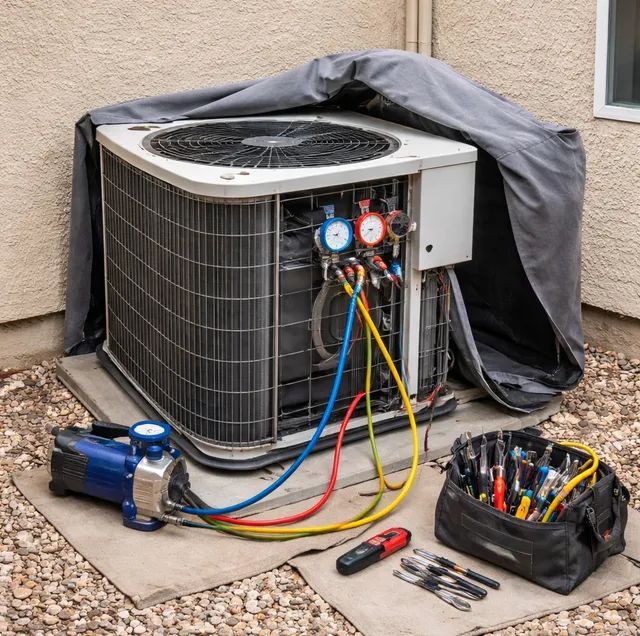
A low charge can also drop the pressure inside the evaporator coil enough to freeze it, which then restricts airflow further and adds to the reason the system will not shut off. Locating the leak, repairing it, and recharging the system to the manufacturer's exact specification is technical work that requires refrigerant handling equipment and training, which is why this step almost always calls for a professional rather than a fix you can make on your own.
Ductwork Can Lose a Significant Share of the Cooled Air Before It Arrives
Ductwork is easy to overlook because it is hidden, but it is frequently where a constantly running system is losing the battle. Federal energy research has found that leaky, poorly insulated ducts running through unconditioned space, like an attic, can account for roughly thirty percent of a cooling system's total energy loss. In a Southern Arizona attic that can climb well above a hundred and thirty degrees on a summer afternoon, any duct running through that space is fighting an enormous temperature difference the entire time it carries cooled air toward your rooms.
Gaps at duct joints, crushed or kinked flex duct, and thin or missing insulation all let cooled air escape or pick up heat before it reaches the registers. The thermostat keeps calling for cooling because the air actually arriving in the living space is warmer and lower in volume than what the system produced, so the equipment runs and runs while a meaningful share of its output never does any useful work.
The angle problem nobody warns you about
Sometimes the Equipment Itself Is Undersized for the Load It Carries
If the system checks out mechanically and the ductwork is sound, the remaining possibility is that the equipment was never matched to the home's actual cooling load in the first place, or the load has grown since it was installed. An addition, a converted garage, new windows facing west, or simply the added heat of a Southern Arizona summer that runs hotter and longer than it used to can all push a home's cooling demand past what an older or undersized unit can deliver. When that happens, a continuously running system is not malfunctioning. It is doing exactly what it can, and what it can do is no longer enough.
Aging equipment adds to this in a different way. Compressors lose a measure of their rated capacity as they wear, so a unit that comfortably handled the house a decade ago may fall behind under the same conditions today. Proper sizing for a replacement or an addition depends on a load calculation performed room by room that accounts for square footage, insulation, window area, and local climate data, not a rule of thumb based on the old unit's size.
TIP: Before assuming the equipment itself is undersized, have a technician measure actual airflow at the registers and check the refrigerant charge against the manufacturer's specification. Airflow and refrigerant problems mimic an undersized system closely, and correcting either one is far less involved than replacing equipment that may be perfectly adequate once it is working the way it was designed to.
A Thermostat in the Wrong Spot Can Mask the Real Problem
A thermostat mounted near a sunny window, a kitchen, or a supply vent reads a temperature that does not match the rest of the house, so it can keep calling for cooling long after the living space is actually comfortable, or fail to register that a room is still too warm. This does not create the underlying capacity shortfall, but it can make a marginal system look worse than it is and complicate the diagnosis. Checking thermostat placement and calibration is a quick early step before assuming the problem lies in the equipment or ductwork.
WARNING: Do not let a system run continuously for days without addressing it, especially if the outdoor unit feels unusually hot to the touch or the breaker has tripped and been reset more than once. Forcing a struggling compressor to keep working under that kind of sustained strain is one of the more common ways a repairable issue turns into a full compressor failure. Shut the system down and get it inspected if you see either of those signs.
Frequently Asked Questions
Is it normal for a central air conditioner to run all day when it is extremely hot outside?
A properly sized system runs during peak heat but should cycle off periodically. If the unit never shuts off and temperature keeps climbing, that signals a real system deficit rather than normal high-demand operation.
How can I tell if my ductwork is losing cooled air before it reaches my rooms?
Signs include rooms that never feel cool, weak airflow at registers, high attic temperatures, and constant operation. Technicians confirm duct losses with pressure testing and visual inspection of accessible runs for gaps, disconnections, and crushing.
Could my air conditioner simply be too small for my house?
It is possible, especially with additions, west-facing windows, or aging equipment losing capacity. A room-by-room load calculation reliably confirms whether your unit matches actual cooling demand or has been undersized all along.
Does a dirty outdoor unit really keep the whole house from cooling?
Yes. The outdoor coil releases heat, and dust blocks that exchange. The refrigerant stays hotter and the system loses meaningful cooling capacity. This is one of the most common and least expensive causes to correct.
Does low refrigerant always mean there is a leak?
Yes. Refrigerant circulates in a sealed system and isn't consumed normally. Low charge always indicates a leak in lines, coils, or fittings. Adding refrigerant without repairing the leak provides only temporary relief before shortage returns.
What happens if I just let the system keep running instead of calling for service?
Letting a struggling system run continuously accelerates wear on compressor and motors. It raises energy use since equipment works near maximum without gaining ground. Early diagnosis usually costs less than waiting for equipment to fail.
Finding Why Your System Cannot Catch Up
A system running continuously without bringing the house down to temperature is working harder and losing at the same time. That pattern is not normal summer operation, no matter how brutal the Arizona heat. It signals something specific is restricting airflow, blocking heat rejection, or draining the system's capacity. Whether that problem lives in the filter, the outdoor coil, the ductwork, or the refrigerant line makes a real difference in how to fix it. Identifying which one stops the guesswork.
Over 35
years serving Benson & Tucson, AZ, Abbey Aire and Building Repair
has seen every version of this specific failure pattern. A system that cannot catch up in peak summer heat usually has a fixable cause sitting somewhere in the chain. The filter, outdoor unit, ducts, refrigerant, or thermostat placement all get checked methodically until the real culprit surfaces. Once found, addressing it returns the system to working the way it was designed and built to work.